I was taught
that what we send
into the world
returns to us.
Kindness for kindness.
Harm for harm.
Every act
finding its way home
threefold.
So I kept my life
on the favorable side
of the equation,
as if goodness
could be entered
on one side of a ledger
and protection
would appear
on the other.
I returned the wallet
with every dollar inside.
Covered the shift
when no one else
would answer.
Apologized first.
Held the door
even for those
who had closed theirs
on me.
When goodness
did not feel like
enough protection,
I began looking
for signs.
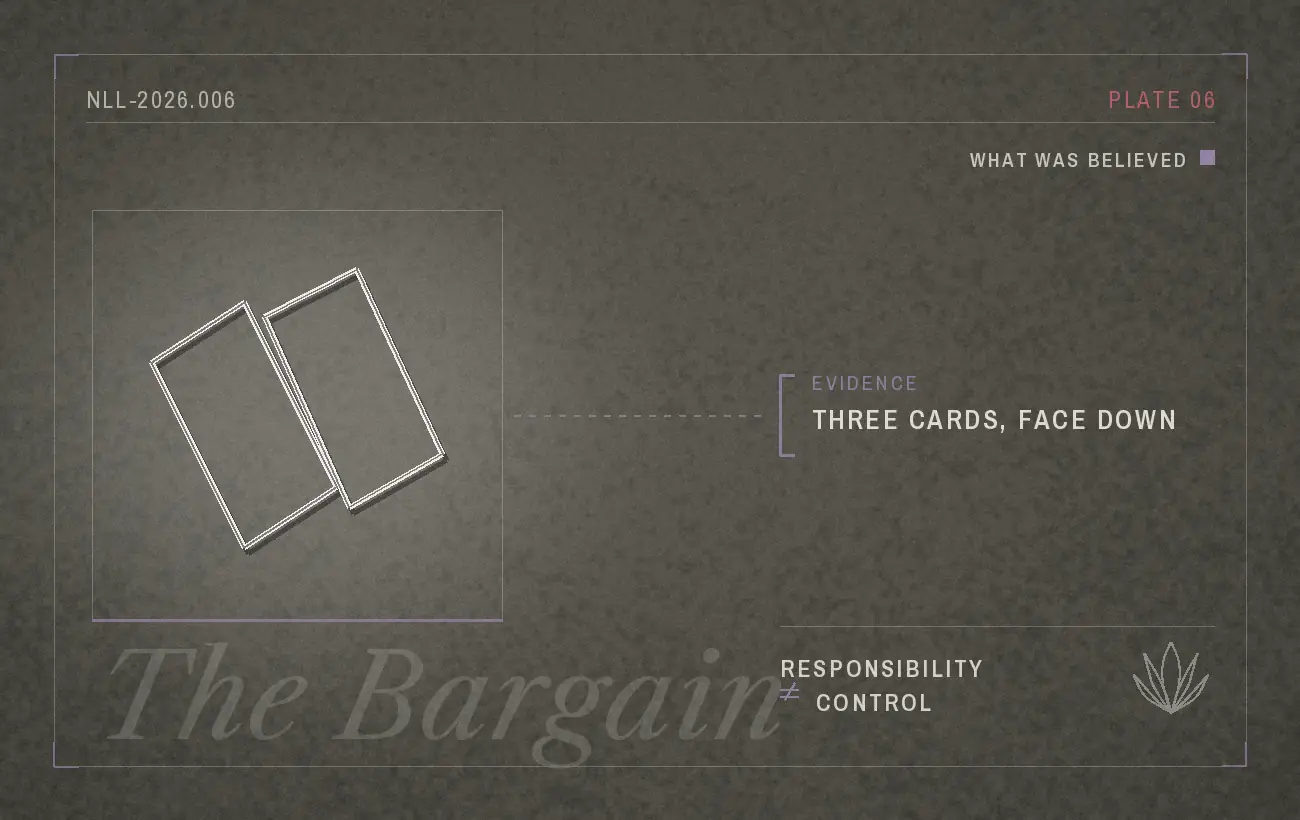
A psychic turned over
three cards
and said the road ahead
was opening.
I kept the crystal
she placed in my palm,
burned sage
through every room,
studied repeating numbers
on receipts and clocks,
called each coincidence
a message
and every delay
a warning.
I believed
that if I read
the signs correctly,
life would reveal
what it planned
to do to me—
and perhaps
let me bargain
my way out of it.
Then the future
I had begun
to count on
became
something else.
The cards
had not shown it.
The numbers
had not changed.
The crystal remained
beside my bed,
clear and silent,
holding all the meaning
I had given it,
but not the power
to prevent
what came.
I searched backward
through every decision,
turning my life
over like a deck,
certain suffering
must have entered
through something
I had failed to notice—
a warning
I had misunderstood,
some goodness
I had neglected
to return.
I did not question
the bargain.
I questioned
myself.
I had turned belief
into a contract:
I would be good.
I would remain vigilant.
I would read
every sign correctly.
And in return,
nothing unbearable
would happen.
I had mistaken
my side of the bargain
for proof
that life
had agreed.
I began to separate
responsibility
from control.
I could choose
which road to take,
not where
it would lead.
I could plant
what I wanted to grow,
give it water,
light,
every season
I had to offer.
I could not make
the earth
owe me a harvest.
No card could promise
the seed would take.
I still believe
there are things
we cannot see.
I still believe
what we give
changes something—
not because goodness
can purchase
a gentler future,
but because it shapes
the person
who must meet it.
The cards remain
face down
beside my bed.
The crystal holds
what is left
of the evening light.
On the clock,
the same numbers
return.
I still catch myself
looking at them
longer than I mean to,
hoping the future
might still be persuaded
to answer differently.