
Skip to content
Nadia LuongLiving Library
The House NLL–2026.001 Nadia Luong Living Library

The Tenderness You Hid

A warm meal, a corrected hand. Two truths held apart for years.

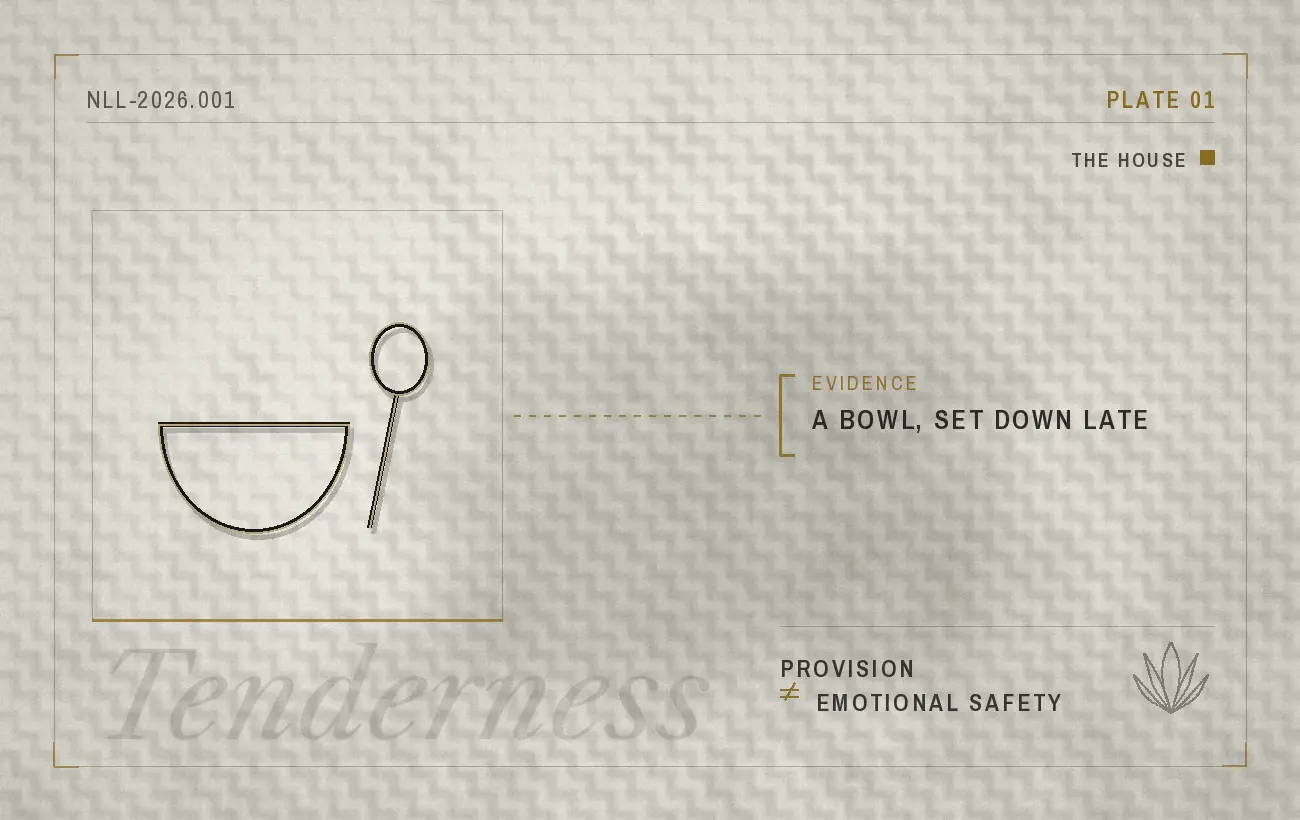
When I was hungry, no matter how late, you went to the stove and made me something to eat. You tied your apron, checked the rice, and tasted the broth before setting the bowl in front of me.
The meal was warm. Your hands were steady. You still corrected the way I held the spoon, the way I sat, the way I looked away. I watched for the next thing I had done wrong.
You stood there as if feeding me and hardening me belonged to the same duty. You thought both would keep me alive.
Before buying anything for yourself, you bought my clothes. You folded each uniform at the foot of my bed, then pointed out the stain I had missed. You set aside money from your paycheck so I could go to school. You waited by the gate with an umbrella when the rain came, then asked why I had not called sooner.
You made sure I had enough. I learned to wonder whether I was enough.
Perhaps responsibility was the tenderness you trusted: a bill paid, food prepared, a child made ready for a difficult world.
The clothes, the money, the meal, the umbrella said I mattered. Your voice, sharp across the kitchen, said I was not enough. I believed them both.
For years, I used what you gave me to argue against what I felt. A full plate became proof that fear was ingratitude.
So I learned to receive care and search it for the correction that might follow. Even when nothing was asked of me, I kept listening.
Love is not only what you give me. It is also what you do not make me earn.
Even now, when someone places a warm meal before me, I lift the spoon. The food is warm. Still, I wait for the warmth to become a warning.

After reading the poem

Love is sometimes easiest to recognize in what someone provides and hardest to recognize in how it feels to receive.

This poem holds two experiences the speaker once believed could not coexist: being deeply provided for and being afraid of the person doing the providing. Food, clothing, education, and responsibility read as devotion. Correction and emotional hardness read as the absence of safety.

It does not settle the contradiction by declaring one version of the parent true and the other false. It asks whether love can be genuine while the form it takes still causes harm. A parent may have learned to express tenderness through provision because tenderness itself was never available to them, an inheritance that can explain the behavior without changing its effect on the child.

What became visible

Provision≠Emotional Safety
Toughness≠Strength
Love Given≠Love Felt

Intellectual value

Refuses the choice between “she loved me” and “she hurt me”: both can be true. What a parent intends and what a child experiences are two separate facts.